
Teeth whitening at home: risks and benefits

Photo: freepik.com/Freepik
The desire for a radiant and white smile is one of the most sought-after aesthetic demands in modern society, but it often prompts people into ill-considered experiments with products of dubious quality. Although advertisements promise miracles, uncontrolled teeth whitening at home without specialist supervision often ends not with a dazzling smile, but with irreversible enamel damage and tooth sensitivity.
Anita Preisa, a hygienist at the Adoria Health and Beauty Centre, explains in the continuation of this article why "mass-produced" products can be dangerous and what the safe alternatives are for improving tooth shade in home conditions
In this article you will learn:
- The variety of whitening methods: how the whitening strips and pastes available on shop shelves differ from individually made trays.
- Safety aspects: whether folk methods with baking soda are permissible and how to protect teeth from sensitivity.
- A professional solution: why teeth whitening in cooperation with a dental specialist provides a safer and more lasting result than experiments on your own.
Are shop products and whitening strips effective?
The range of products available on the market is truly wide, and often the first, frequently mistaken, step is the search for the best whitening toothpaste. But it is important to realise that most of these products do not chemically change the tooth's natural colour (as professional gels do), but rather work at the expense of high abrasiveness. They contain hard microparticles that mechanically "scrub off" the surface pigment from coffee or tea.
Although the smile may visually become a little lighter, the regular use of such aggressive pastes irreversibly scratches the enamel surface. As a result, the teeth not only become sensitive, but also lose their natural shine and, paradoxically, become even more susceptible to new pigmentation, because colourants adhere more easily to a rough surface.
The so popular whitening strips, in turn, contain chemical substances, usually hydrogen peroxide in a low concentration, which can act more deeply. However, whitening strips have a significant drawback – they are not adapted to the individual shape of the tooth row, and their use in home conditions can also be dangerous and cause mucosa burns and other problems.
- Uneven coverage: the strips may not fit tightly to all teeth, creating an uneven whitening effect.
- Gum irritation: standard-size strips often come into contact with the gums, causing a chemical burn or inflammation.
- The influence of saliva: without precise isolation, saliva can dilute the active substance, reducing its effectiveness.
- Mucosa damage: improper use of the product can traumatise the inner mucosa of the cheek and lip, as a result of which ulcers can form that heal slowly and painfully.
- Impact on existing restorations: uncontrolled whitening can make existing fillings or crowns rough and unaesthetic, because whitening substances act only on the natural tooth enamel, creating stark colour differences.
Therefore, when choosing non-professional products for teeth whitening, it is always advisable to consult a specialist beforehand about their composition and safety.
Is it permissible to whiten teeth with baking soda and lemon?
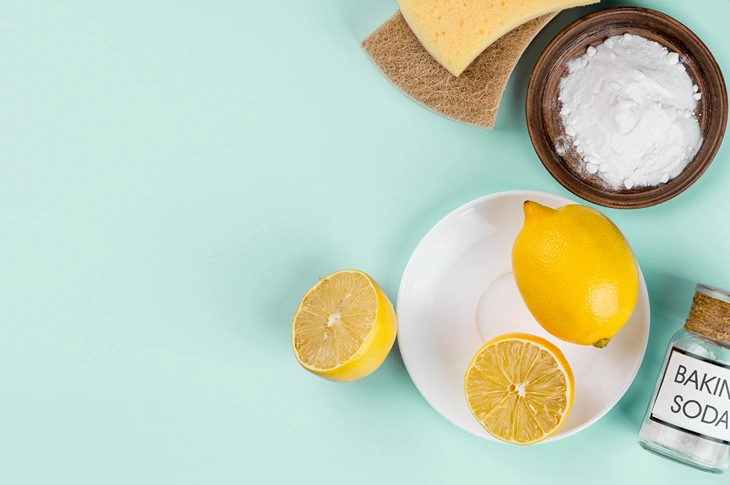
Photo: freepik.com/Freepik
Although "folk methods" are still promoted on social networks and various forums, to the question – is it permissible to whiten teeth with baking soda and lemon? – dental specialists give an unequivocally negative answer.
This combination is extremely aggressive and dangerous to the tooth structure. Citric acid chemically softens the enamel (demineralisation), while baking soda acts as a strong abrasive material. As a result, the tooth's protective layer is literally "scrubbed off". Although initially the teeth may look whiter, in the long term the enamel becomes thinner, more transparent, and the yellowish dentine begins to show through, achieving the opposite effect.
Likewise, the shine of the enamel is irreversibly lost and tooth sensitivity increases considerably. Safe teeth whitening at home never involves the use of kitchen products, because the damage caused is often irreversible, and the restoration of dental aesthetics may later require expensive prosthetics with veneers or crowns.
Why is teeth whitening with trays the only safe choice for home procedures?
The safest and most predictable way to make a smile lighter in home conditions is teeth whitening with trays made in a dental clinic. This method combines professional supervision, the possibility to plan this process and carry it out in conditions convenient for you, as well as a predictable and safe result.
The process begins with a visit to a hygienist, who takes precise tooth impressions in order to make individual trays in a laboratory. This method has several significant advantages compared to the whitening strips and pastes available in shops.
- Precise fit and action: since the trays are individually made based on impressions of the patient's tooth row or a digital scan, they tightly embrace each tooth. This ensures an even distribution of the gel and maximum contact with the enamel even in hard-to-reach places, guaranteeing an aesthetically uniform result without unwhitened areas.
- Gum protection: the individual design is developed so that the edge of the tray precisely follows the gum line. This prevents the active gel from leaking onto the soft tissues, avoiding the risk of chemical irritation and painful mucosa burns.
- Controlled concentration: the doctor chooses the most suitable concentration of carbamide peroxide, taking into account the patient's enamel thickness, sensitivity threshold and desired result, which is not possible when using standard shop products.
- The reversibility and flexibility of the process: when using trays, the patient can regulate the frequency of whitening themselves. If sensitivity appears, the procedure can be temporarily stopped or carried out less often, without losing the achieved effect.
- Long-term economic benefit: individually made trays are durable and serve for several years. This means that in the future, when wishing to refresh the smile's shade, it will only be necessary to purchase the whitening gel, rather than the whole set anew.
- Professional support: throughout the whitening course the patient is under the supervision of a specialist, who can promptly provide recommendations for reducing sensitivity or improving the result.
By choosing this method, teeth whitening at home becomes a controlled process in which the patient can themselves regulate the intensity of whitening, monitoring the teeth's reaction and the dentist's instructions.
Does teeth whitening damage the enamel and cause sensitivity?
Photo: pexels.com/Pexels
One of the most widespread myths is the assumption that the whitening process irreversibly damages the tooth's protective layer. But when using certified products in a controlled concentration, the enamel structure and its density are not negatively affected. The active substance (peroxide) penetrates the tooth's hard tissues through the enamel prisms and oxidises the organic pigments accumulated there, without changing the tooth's shape or mechanical strength.
However, sensitive teeth after whitening is a frequently encountered, though transient, side effect. This happens because during the procedure the dentine tubules open, making the tooth nerves more susceptible to temperature fluctuations. To reduce the discomfort:
- Usage regimen: if sensitivity appears, it is advisable to use the trays every other day or reduce the exposure time.
- Remineralisation: during the course and after it, it is advisable to use special gels or pastes with calcium and fluorides, which "close" the open tubules and calm the nerve.
- Avoiding irritants: during the process it is not advisable to consume very cold or hot drinks.
How much does the procedure cost and how lasting is the result?
When planning a budget, teeth whitening prices are often compared between non-professional products and the dental offer. Although the initial investment in making individual trays is greater than for the whitening sets or pastes available in shops, in the long term it is more economically advantageous. The trays serve for years – to refresh the shade after a year or two, it is only necessary to purchase a syringe of professional gel, which is a relatively cheap purchase.
Patients are also interested in how long the teeth whitening effect lasts. When choosing professional teeth whitening with trays, on average the result is maintained from 6 months up to 2 years, but this directly depends on lifestyle. Staining products (coffee, tea, red wine), smoking and careless daily hygiene contribute to a faster return of the pigment.
By contrast, when using non-professional whitening products, the effect is very short-lived – often it disappears already after a few weeks, because these products cannot act in the deeper tooth tissues. To maintain the professionally obtained radiance for a long time, regular visits to the hygienist and maintenance whitening help, for example, one night with the individual trays every six months.
Frequently asked questions about teeth whitening at home
To make a safe decision, it is worth summarising the most essential answers to patients' questions.
- Is it permissible to whiten teeth with baking soda and lemon?
No, this method is very harmful. It causes irreversible enamel erosion and damage, which may later have to be corrected with expensive restorations. Moreover, such a combination of acid and abrasive creates microscopic cracks into which staining pigments from food penetrate even more deeply, making the teeth visually darker than before the procedure.
- How long does the teeth whitening effect last?
The effect is individual, usually from 6 months to 2 years. It is significantly influenced by the patient's dietary habits and the quality of oral hygiene. It is important to take into account that professional teeth whitening at home provides a more lasting result, because the individual trays allow the active substance to evenly and deeply saturate the enamel, while the effect of mass-produced products often disappears already within a few weeks.
- Does teeth whitening damage the enamel?
No, if the process takes place under the supervision of a professional with certified materials. The enamel is not "scrubbed off" or mechanically damaged, but rather chemically cleansed of the organic pigments. A correctly performed procedure does not affect the density of the tooth's hard tissue, but it does make the enamel temporarily more permeable, which is why during the course it is essential to follow the specialist's instructions.
Obtain a radiant smile with the help of Adoria specialists!
Photo: adoria.lv
For teeth whitening at home to provide the expected result without risk to health, entrust the transformation of your smile to professionals. The Adoria Health and Beauty Centre offers to make individual, high-precision trays and provides professional whitening products that are gentle on your teeth. Book an appointment with a hygienist by calling +371 67 315 000 or by filling in the application form on the website, and take the first step towards a confident smile.