
Teeth Whitening: What Methods Are Available?
Photo: freepik.com/Freepik
One of the most sought-after aesthetic dentistry services is professional teeth whitening, but nowadays other methods for improving tooth shade are also available. Professional teeth whitening at the dentist's office, whitening trays and at-home whitening products – how these methods differ and what to consider when making a choice is discussed in this article by Dana Zālīte, director of the Health and Beauty Centre Adoria.
Professional Teeth Whitening at the Dental Office
The most effective and safest method for improving tooth shade is professional teeth whitening, performed under the guidance of a qualified specialist – a dentist or dental hygienist. This approach delivers significantly faster and more effective results compared to at-home solutions.
During the procedure, a whitening gel is carefully applied to the tooth enamel. It contains active substances, most commonly hydrogen peroxide or carbamide peroxide, in a concentration significantly higher than that found in freely available products. The higher concentration makes it possible to achieve visible shade changes within a single appointment, which typically lasts from 60 to 90 minutes.
Before applying the active gel, the specialist carefully isolates the gums and soft oral tissues, preventing direct contact of the gel with sensitive tissues, thus protecting against the risk of irritation or burns. To enhance whitening effectiveness and accelerate the chemical processes, many professional teeth whitening systems integrate photoactivation technologies. Once the whitening gel has been applied to the tooth surfaces, controlled light sources are used, such as an LED lamp of a specific wavelength.
This accelerates the breakdown of peroxide molecules, thereby promoting a more intense and faster release of active oxygen radicals, which are responsible for breaking down pigment molecules in the tooth tissues. As a result, this technology allows for more pronounced tooth shade changes in a shorter time, compared to whitening without light or laser activation.
- How effective is professional teeth whitening, what influences the results of the procedure and how to maintain them for as long as possible? Find out by reading the article prepared by our specialists: "Find out how effective professional teeth whitening is!"
Before the whitening procedure, the specialist conducts a thorough assessment of the condition of the teeth and gums. The purpose of this examination is to identify possible contraindications, such as untreated cavities, acute gum inflammation (gingivitis or periodontitis), enamel cracks or exposed tooth necks.
Teeth whitening in such cases can cause not only severe tooth sensitivity, but also pain or even more serious damage, which is why this prior diagnosis is critically important for the safety and effectiveness of the procedure. It is precisely the specialist's knowledge that allows them to evaluate each patient's individual situation and ensure the suitability of the procedure.
Teeth Whitening with the Fläsh System – A Modern Approach
The Fläsh system, manufactured in Germany, is one of the most modern and gentle professional teeth whitening systems, recommended by dental specialists worldwide. Teeth whitening with Fläsh stands out for several advantages that make the procedure not only more effective, but also more comfortable.
The Fläsh system has been developed by combining a uniquely formulated whitening gel with an innovative LED technology lamp that provides the optimal light spectrum for activating the active whitening agents. A key advantage of LED technology, compared to older generation lamp systems, is minimal heat generation. This significantly reduces the risk of overheating the tooth pulp, which is one of the most common causes of increased tooth sensitivity after whitening procedures.
Furthermore, the Fläsh system's whitening gel is specially formulated to ensure not only effective tooth shade changes, but also increased patient comfort. Its composition is often supplemented with specific desensitising components, such as potassium nitrate or similar substances. These compounds help calm the tooth nerve or block dentinal tubules, thereby actively reducing potential tooth sensitivity both during and after the procedure. This thoughtful approach allows for excellent aesthetic results with minimal discomfort.
The procedure typically lasts approximately one hour, and as a result it is possible to achieve a 5 to 10 times lighter tooth shade, depending on individual factors. Before any professional teeth whitening, including with the Fläsh system, a consultation with a dentist or dental hygienist is mandatory. The specialist will carefully assess the condition of the teeth and oral cavity to rule out possible contraindications. Based on this assessment, and taking into account the client's initial tooth shade and enamel characteristics, the specialist will also discuss the realistically achievable whitening result.
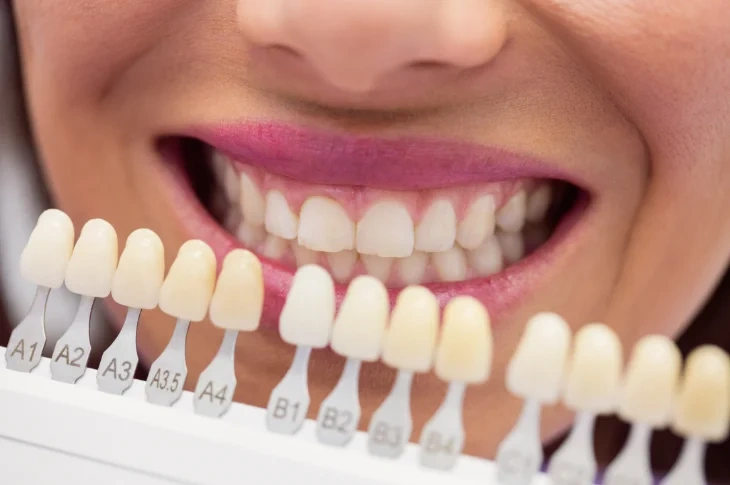
Photo: freepik.com/Freepik
Professional Teeth Whitening Trays for Home Use
An alternative to professional in-office whitening is teeth whitening trays, which are made individually at the dental clinic but used at home. This method combines a professional approach with the convenience of home use.
The process begins with a visit to the dentist or dental hygienist, who takes dental impressions. Based on these impressions, thin, transparent plastic trays are made in a dental laboratory that precisely fit the tooth surfaces. Together with the trays, the patient receives a professional whitening gel, which usually contains a lower concentration of the active substance than the one used in the office.
The specialist provides precise instructions on the amount of gel to be placed in the trays and the duration of use – usually the trays should be worn for several hours a day or overnight, with the course length varying from a few days to a couple of weeks, depending on the desired result and gel concentration.
The main advantages of this method are the ability to carry out whitening at a convenient time and place, as well as a more gradual result, which some patients find more natural. Also, although the procedure takes place at home, it is still carried out with professional oversight – the initial assessment, individual tray fabrication and selection of the appropriate gel are performed by a specialist.
However, this method also has its own aspects to consider. The result is achieved more slowly than with in-office whitening, and is also not as effective. It also requires greater patient discipline and precise adherence to instructions to avoid an uneven result or gum irritation if too much gel is placed in the trays. Improper use can also cause increased tooth sensitivity.
Photo: adoria.lv
Non-Professional Teeth Whitening Products
Various non-professional teeth whitening products are widely available on the market, purchasable without a prescription at pharmacies, supermarkets or online. These include whitening toothpastes, whitening strips, brush-application gels, as well as universal trays with a whitening agent.
The main appeal of these products is their lower price and wide availability. However, it is important to understand that their effectiveness and safe use can vary considerably. Whitening toothpastes primarily remove surface pigments (from coffee, tea, smoking), but do not significantly change the internal shade of the tooth itself. Their abrasiveness can be elevated, so prolonged use can potentially damage enamel.
Whitening strips and gels contain lower concentrations of whitening agents than professional products. Although they can provide some whitening effect, the result is usually less effective and short-lived. Furthermore, since the strips or universal trays are not individually fitted, there is a risk that they do not cover the teeth evenly, producing a patchy result, or the whitening agent may come into contact with the gums, causing irritation, burns to the oral mucosa and in the long term even gum inflammation and tooth enamel damage.
It is important to be cautious about various miracle remedies or methods that promise instant and dramatic results at a low price, especially when advertised on social media or various websites. Therefore, the safest and most effective path to a whiter smile is always a consultation with a dental specialist.
- Various folk remedies for improving tooth shade are still popular. Although some home remedies, such as baking soda or activated charcoal, are promoted for this purpose, their effectiveness has not been scientifically proven, and their abrasive action can irreversibly damage tooth enamel. Find out more by reading the article: "Natural Methods for Teeth Whitening: Do They Work?"
What to Consider Before Teeth Whitening?
Regardless of the chosen method, before starting teeth whitening it is essential to take several factors into account and prepare carefully.
- Oral health: before any whitening procedure, it is mandatory to visit a dentist or dental hygienist to assess the condition of the teeth and gums. Any cavities must be treated, gum inflammation must be resolved and professional dental hygiene must be performed to remove tartar and plaque. Whitening may only be carried out when there are no acute dental or oral diseases.
- Suitability: teeth whitening is not recommended for everyone. It is generally not performed on children and adolescents under 18 years of age, pregnant women and women who are breastfeeding. Whitening is also not effective on artificial restorations – fillings, crowns, veneers, bridges. If such restorations are present in the smile zone, they may need to be replaced after whitening to match the new tooth shade. For people with pronounced tooth sensitivity, enamel cracks or exposed tooth necks, whitening may be contraindicated or must be carried out with special caution.
- Realistic expectations: it must be understood that the whitening result is individual and depends on the initial tooth shade, enamel characteristics and the cause of pigmentation. It is not always possible to achieve a Hollywood smile, and the goal is to restore a naturally lighter shade without harming dental and oral health.
- Possible sensitivity: after a teeth whitening procedure, especially after in-office whitening methods, temporary tooth sensitivity to cold or hot may occur. It usually disappears within a few days. The specialist may recommend using sensitivity-reducing toothpastes or performing tooth fluoridation. Professional tooth fluoridation is a procedure during which a fluoride-containing preparation (varnish or gel) is applied to the tooth surface. This helps strengthen tooth enamel, making it more resistant to the effects of acids and reducing sensitivity. This procedure is particularly recommended after whitening to help restore enamel structure and provide additional protection.
- Durability of results: the results of teeth whitening are not permanent. Their durability depends on lifestyle habits – diet (consumption of coffee, tea, red wine, coloured foods), smoking and oral hygiene. To maintain results for longer, careful daily hygiene and regular professional hygiene visits are necessary. Periodic maintenance whitening procedures and tooth fluoridation may be required.
When choosing the most suitable teeth whitening method, it is important to consult a dental specialist who will help evaluate all options, taking into account individual needs, preferences and oral health condition. A professional approach ensures not only an effective, but also a safe path to a more beautiful smile.
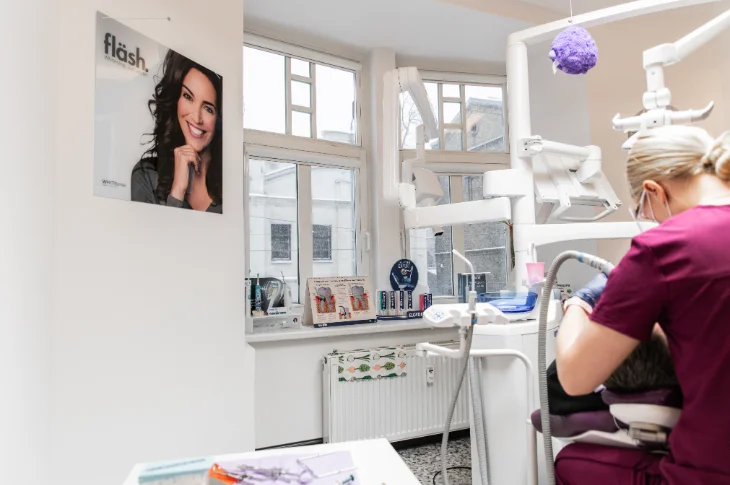
Photo: adoria.lv
Professional Teeth Whitening at Adoria Dentistry
The Health and Beauty Centre Adoria offers modern and safe solutions if you want to achieve a radiant and well-groomed smile. Our specialists provide the highest quality teeth whitening procedures, using the gentle and effective Fläsh teeth whitening system, or individually made professional whitening trays. Book your appointment now!